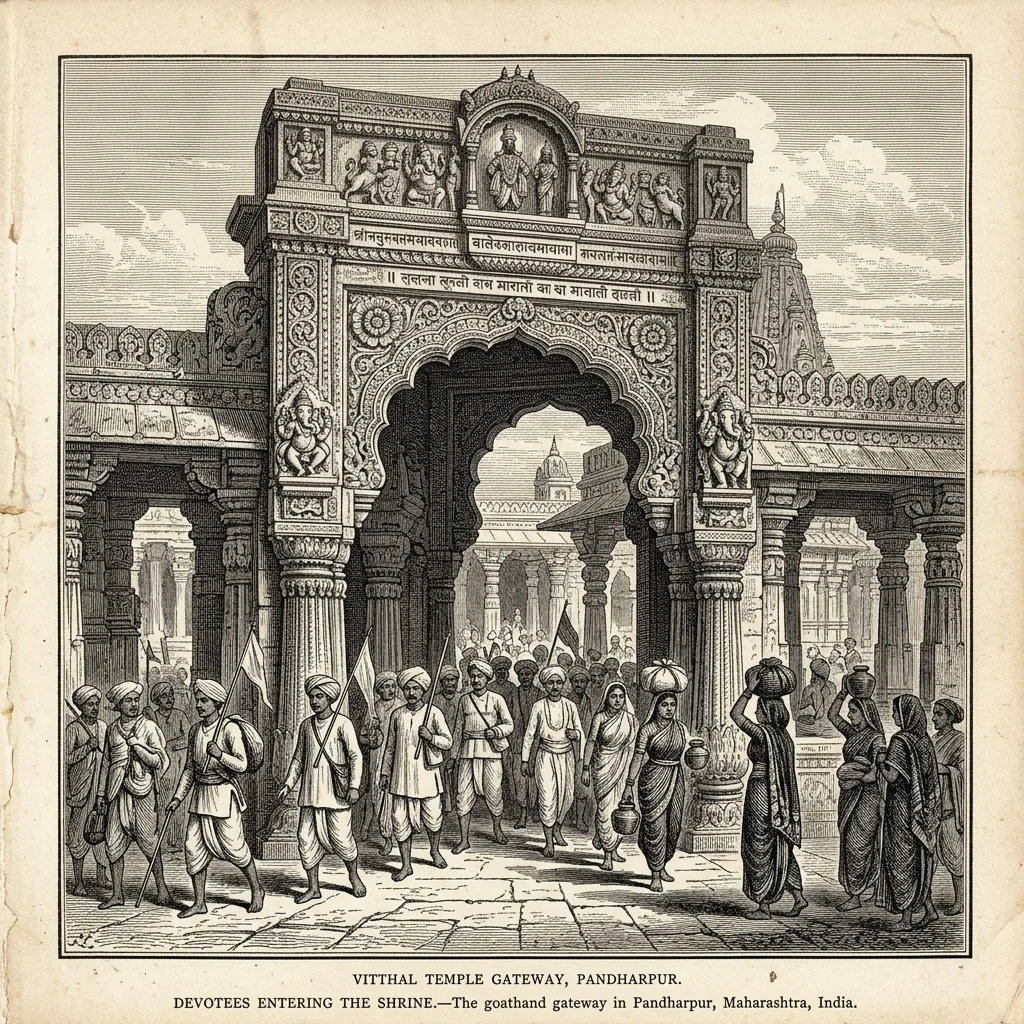
VITTHAL TEMPLE ENTRANCE, PANDHARPUR
Nana's battles over religion were not only about protecting Hindu practices from colonial interference. He also challenged exclusion within Hindu society itself.
During a severe epidemic, the British government imposed a ban on devdarshan at the sacred Vitthal Temple in Pandharpur during the Ashadhi and Kartiki Yatras to prevent disease from spreading through the enormous crowds. But the ban carried a heavy cost, denying pilgrims access to a sacred place and disrupting local traders who depended on the pilgrim economy.
Nana went directly to the Governor. Rather than simply demanding that the restrictions disappear, he pushed for strict health and disease-prevention measures to be used instead of a blanket closure. The ban was lifted.
But while dealing with the immediate crisis, Nana encountered another problem inside the temple: non-Brahmins were not allowed into the inner sanctum and had to take darshan from outside the door.
Challenging Caste Exclusion: Nana objected to this exclusion and began efforts with the Governor and temple authorities to open the temple to devotees regardless of caste, pre-dating the famous temple entry movements of the 1920s like the Vaikom Satyagraha by decades.
His push for the rights of the backward classes earned him the profound admiration of Mahatma Jyotiba Phule, who praised Nana's generosity and his advocacy for lower-class education through the Board of Education.
For Nana, protecting religious freedom did not mean protecting every existing practice. Sometimes, it meant asking who was being allowed through the door.