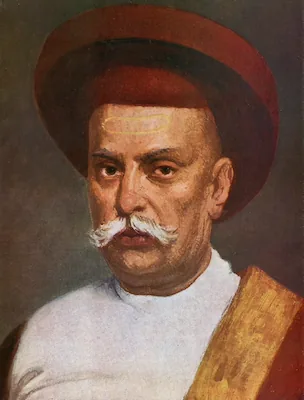
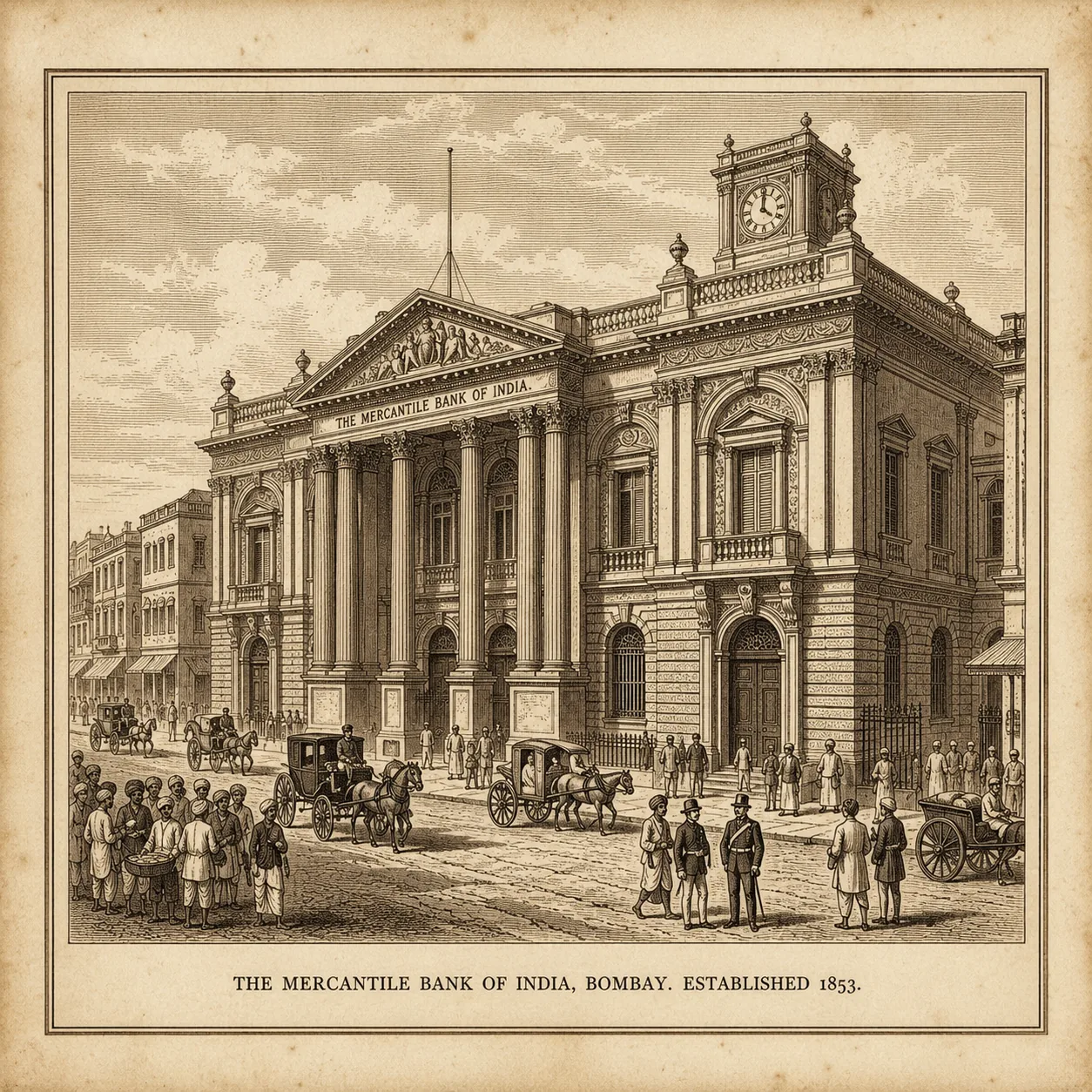
Mercantile Bank of India, Bombay (Established 1853)
Jagannath “Nana” Shankarshet and the Making of Modern Finance in Bombay
What happens when a young man inherits one of Bombay's great traditional fortunes just as the city is beginning to invent modern banking?
At nineteen, Nana Shankarshet inherited more than money. He inherited a family pedhi whose greatest asset was trust: the relationships, reputation and commercial networks that allowed merchants to place their fortunes in Shankarshet hands. Over the next four decades, Nana helped carry that old financial power into a very different world: joint-stock banks, international trade, institutional finance and the rapidly expanding commercial economy of Bombay.
He became a director and founding participant in banks that connected Bombay to Britain, China and wider global markets. But Nana's financial story becomes more complicated as the city's prosperity accelerates. He was part of the financial establishment during the extraordinary cotton boom of the 1860s, even as he warned against the speculation that was driving Bombay's Share Mania. He argued for regulation, reserves and the preservation of capital while others chased extraordinary returns.
Then the boom collapsed.
Nana died just as the financial crisis was beginning to unfold, leaving behind an estate that had exposure to the speculative economy but was also anchored in more stable assets. That distinction would matter. His wealth survived sufficiently for the philanthropic commitments he had built during his lifetime to continue.
The story that follows is therefore not simply about the banks Nana helped create. It is about the transformation of wealth itself in 19th-century Bombay, and a man trying to participate in the new financial world without allowing it to consume what he had inherited.
1. The Shankarshet Family Pedhi and Traditional Banking
Long before Bombay had modern banks, the Shankarshet family was already part of the city's financial life.
The family's story began further north. Narayan Sheth traded in pearls in Porbandar. His descendant Babul Sheth moved through Murbad and Ghodbunder before eventually settling in Bombay, where he established a family pedhi, a traditional trading, credit and moneylending house.
The move to Bombay was not simply a business decision. Ghodbunder had become a dangerous place during the Maratha-Portuguese conflict of the 1730s, and Bombay, under British control, offered a more stable environment for merchants and trade.
Babul's son, Shankar Sheth, expanded the family's commercial relationships. He spoke English, Portuguese and Gujarati and had experience working in an English trading firm, giving him an unusual understanding of the different communities and commercial systems that were converging in Bombay.
His pedhi was more than a place where money changed hands; the family reputation itself became a form of financial capital.
Foreign merchants arriving in Bombay, including Arab and Afghan traders, needed local people they could trust. Shankar Sheth became a guarantor and custodian for merchants who had capital but lacked established relationships in the city.
The Family Treasury (c. 1800):
By around 1800, the family had accumulated extraordinary financial resources. Historical accounts put the pedhi's liquid cash at about ₹16 lakh, with another ₹1.5–2 lakh held in precious jewellery. For a young Bombay still developing its formal financial institutions, that was enormous wealth.
But perhaps more important than the size of the fortune was the trust surrounding it. When Nana inherited the family business after his father's death in 1822, he was just nineteen. He inherited the family's money, but he also inherited decades of commercial relationships and a reputation that had been built on other people's willingness to place their wealth in Shankarshet hands.
Nana did not simply preserve that inheritance. During the 1820s and 1830s, he began moving the family's wealth into land and emerging commercial enterprises, building holdings in places such as Girgaon and Tardeo while becoming involved in the new joint-stock economy taking shape around him.
Transition from Pedhi to Institution: This marked the vital shift in the Shankarshet financial story. While the family had begun with a traditional pedhi built on personal trust and networks, Nana was now helping move that native capital into modern joint-stock banking institutions.
By the 1840s, the family's financial world was beginning to change with Bombay itself. Nana helped establish the Bank of Western India in 1842, a bank in which Indian capital could play a significant role. When it was reconstituted as the Oriental Bank in 1845, Nana served as a Director. That same year, he also helped found the Commercial Bank of India.
The surviving evidence gives us a glimpse of how significant that transition was: contemporary Bombay directories list “Jugonnath Sunkersett, Esq.” as a Director of the Bank of Western India, while later accounts record the family's substantial property holdings in Girgaon and Tardeo.
And there is still a physical trace of the family's early wealth. The Bhavani-Shankar Temple in Tardeo, built by Shankar Sheth in 1806, survives today. The temple and its deepstambha offer one of the tangible links to the world in which the family's pedhi first prospered.
The story, then, is not simply about how Nana became wealthy. It is about how he inherited an older form of financial power, based on family reputation, personal relationships and trust, and helped carry it into Bombay's emerging world of banks, joint-stock companies, land development and institutional finance. That ability to move between the old and the new would become one of the defining features of Nana's career.
2. Bank of Western India (1842)
By the late 1830s, Bombay's trade was growing rapidly, but its financial system had not caught up. Merchants still depended heavily on private European agency houses and wealthy Indian moneylenders for credit. The government-backed Bank of Bombay dominated the formal banking system, but a group of merchants believed there was room for a different kind of institution.
In 1842, they created the Bank of Western India.
Nana Shankarshet was one of its founding directors and one of only two Indian directors on the board, alongside the Parsi philanthropist Sir Jamsetjee Jeejeebhoy. His involvement brought something the new bank could not simply buy: established relationships and credibility within Bombay's Indian commercial community.
Nana was not simply lending his name to the venture. He was one of its primary original subscribers, putting his own capital behind a new form of joint-stock banking at a time when it was still unproven in Bombay. His presence also helped reassure Indian merchants who might otherwise have been wary of putting their money into a British-style financial institution.
The Bank of Western India was willing to pursue forms of exchange banking and lending that the government-backed Bank of Bombay could not. What began as a new bank therefore became a challenge to the existing financial order.
The Restructuring to Oriental Bank (1845):
In 1845, the Bank of Western India was reorganised as the Oriental Bank Corporation and moved its headquarters to London. The strategy was intended to put the institution beyond the direct reach of the East India Company's local restrictions and secure a Royal Charter from the British Crown.
The transformation was remarkable. A bank that had begun in Bombay with Indian participation was becoming an international financial institution. Its capital base expanded dramatically, and the Oriental Bank eventually became a major force in banking across the East.
Nana stood at the intersection of two financial worlds, taking the trust of traditional pedhis and helping build modern banks.
The old system was not simply disappearing; it was becoming part of something new.
There was also a very physical reminder of where the story began. The Bank of Western India's first office was at Rampart Row. Its successor, the Oriental Bank Corporation, later occupied the grand Oriental Building near Flora Fountain. The building survives. Standing at Flora Fountain today, it is possible to see the kind of institution Nana helped bring into Bombay's financial landscape: a visible symbol of the city's transition from private merchant finance to modern banking.
For Nana, banking was therefore not just another investment; it was a strategic piece in the transformation of Bombay, taking the trust and capital of its native merchant community and positioning them inside the emerging world of institutional finance.
3. Commercial Bank of India (1852)
As Bombay's export trade expanded, merchants needed more ways to finance the growing business around them.
The Commercial Bank of India was established in 1845 as a joint-stock bank, although it underwent a major recapitalisation or charter change in 1852. Nana Shankarshet served as a founding director, and his son, Vinayakrao Jagannath, later joined the board, extending the family's involvement in Bombay's financial institutions into the next generation. The bank initially served local trade, giving Indian merchants another source of credit alongside the larger European exchange banks.
But it did not remain a purely local institution. During the 1850s, the Commercial Bank expanded into exchange banking, establishing branches in London and in China's major trading centres, including Canton, Shanghai and Hong Kong. A Bombay bank was now connected directly to the commercial networks linking India with Britain and East Asia.
Nana's role was particularly important because the bank needed to operate across two different worlds.
Bridging the Bazaar and the Boardroom:
While the bank's British managers understood formal banking, Nana understood Bombay's Indian commercial community. Native directors played a critical role in assessing the creditworthiness of Indian merchants and their hundis (traditional bills of exchange), connecting formal finance with the bazaar economy.
And the scale of the business changed dramatically.
The Speculative Boom and Collapse (1861-1866):
When the American Civil War disrupted the world's cotton supply between 1861 and 1865, Bombay became a major centre of the resulting cotton boom. The Commercial Bank participated in financing the extraordinary expansion of trade and commerce that followed.
Nana died on July 31, 1865, just as that boom was reaching its height. Less than a year later, the financial world began to unravel. The collapse of Overend, Gurney & Co. in London in May 1866 sent shockwaves through international markets, and the Commercial Bank of India, heavily exposed to trade finance, was forced into liquidation.
It gives this part of Nana's financial story an unusual ending. The bank he helped build did not simply grow steadily into permanence. It became an international institution, rode one of Bombay's greatest commercial booms, and then collapsed in the financial shock that followed.
Nana did not abandon the old networks of Indian commerce when modern banking arrived. He helped bring them into the new institutions.
4. Mercantile Bank of India, London, and China (1853/1854)
The Mercantile Bank of India, London, and China was established in Bombay in 1853 and formally opened for business on January 3, 1854. It was created at a time when the East India Company still held a powerful grip over banking and finance in India. The new bank challenged that dominance, connecting Bombay's merchants to the commercial centres of Britain and China.
Nana was not simply an investor in the new institution. He was one of only two Indian directors on its founding local board, alongside the Parsi financier Cowasji Jehangir Readymoney. Their presence mattered: Indian merchants were being given a place in a bank that dealt directly with international trade and finance.
The bank's early years were not straightforward. Because it had not initially received a Royal Charter, it operated without some of the protections and privileges enjoyed by chartered British banks. Its directors spent several years lobbying in London for recognition, and in 1857, the bank finally received its Royal Charter and became the Chartered Mercantile Bank of India, London and China, with its legal headquarters in London.
For Nana, the bank was another point of connection between Bombay's traditional trading networks and the increasingly international world of finance. His relationships with Arab, Afghan, Gujarati and other merchants connected him to the city's commercial community, while his position on the board placed him inside an institution dealing in deposits, foreign exchange and international trade.
Then Bombay entered one of the most extraordinary economic booms of the nineteenth century. During the American Civil War, the disruption of American cotton exports sent cotton prices soaring. Bombay became enormously wealthy, and speculation surged across the city. The Mercantile Bank was operating at the centre of this rapidly expanding financial world. When the boom finally collapsed in the Crash of 1866, the consequences were severe. The Bank of Bombay went into liquidation, while the Mercantile Bank survived, although not without heavy losses.
Nana did not live to see how the institution's story would unfold. He died on July 31, 1865, at the height of Bombay's economic transformation. But the bank he had helped establish continued.
Evolution to a Global Network:
After difficulties in the early 1890s, the original institution was reconstructed in 1893 as the Mercantile Bank of India. By the 1950s, it had become Mercantile Bank Limited. The Hongkong and Shanghai Banking Corporation (HSBC) acquired the bank in 1959, and full integration was completed in 1984. The institution that began in Bombay in 1853 had by then become part of the larger international banking network of the HSBC Group.
The name changed. The institution changed. But the financial story that began in Bombay in Nana's lifetime continued into the international banking network that eventually became part of the HSBC Group.
The Mercantile Bank was more than a commercial association; it showed Nana participating in a moment when Bombay was connecting to global finance.
5. The Bombay Share Mania and Speculative Crash (1865-1866)
The outbreak of the American Civil War in 1861 triggered an unprecedented economic boom in Bombay. With the Union blockade cutting off the supply of American cotton to British textile mills, Lancashire turned to India. Bombay's cotton exports doubled, and the resulting influx of wealth was staggering: between 1861 and 1865, Bombay accounted for Rs. 52 crore in bullion imports.
But the boom did not stop with cotton. Flush with cash, Bombay's merchants and speculators began pouring money into banks, financial associations and ambitious ventures. Share prices rose to extraordinary levels. The city had entered what became known as the Bombay Share Mania.
Nana was not watching this frenzy from the sidelines. He was a director of the Bank of Bombay, where he had served as a "Native Director" for more than two decades. He was also a promoter and director of the Back Bay Reclamation Company, one of the biggest speculative ventures of the period.
The financial system itself was helping fuel the boom.
Speculative Inflation and the Bank of Bombay:
In 1863, the Bank of Bombay’s charter was revised to allow the bank to lend against shares in public companies. By 1864, speculation was at its peak. Shares in the Back Bay Reclamation Company with a paid-up value of Rs. 5,000 were trading at premiums of Rs. 25,000.
Then the world changed.
In April 1865, news that the American Civil War had ended reached Bombay. American cotton could once again reach European markets, and the extraordinary demand for Indian cotton began to disappear. The reckoning came on July 1, 1865, when many speculative "time bargains" came due for settlement. The market had fallen so sharply that buyers could no longer meet their commitments, and an estimated Rs. 45.80 crore was wiped off the market's value.
It was a financial disaster. Hundreds of companies failed. The Bank of Bombay struggled under bad debts, many connected to the Back Bay Reclamation Company. The institution was effectively finished by the end of 1866, went into formal liquidation in 1867, and closed permanently in 1868, when a new Bank of Bombay opened in its place.
And Nana was still there when the crash arrived. He died at his home in Girgaon on July 31, 1865, exactly one month after the great market settlement that had shaken Bombay.
The Share Mania therefore tells a more complicated story about Nana than simply that of a man caught up in Bombay's speculative fever. He was a director of its banking system, a promoter of one of its largest speculative ventures, and part of the financial establishment that helped fuel the boom. But when the boom ended, he was no longer there to see what followed. His estate, holding the Bank and Back Bay shares until his death, faced the consequences of the collapse.
The crash devastated Bombay's financial landscape and ruined countless merchants and brokers. Some of those displaced from the formal financial system eventually gathered under a banyan tree, laying part of the grassroots foundation for what would become the Bombay Stock Exchange on Dalal Street in 1875.
6. Cautious Financial Management and Estate Insulation
While the Share Mania consumed Bombay's financial elite, Nana Shankarshet took a notably cautious view of speculation.
The Legislative Attempt to Curb Speculation (1863):
In 1863, as share trading was becoming increasingly feverish, Nana took that concern into the Legislative Council. He participated in the debate over the Stock-jobbing Bill, arguing that speculative trading was damaging the legitimate mercantile character of Bombay. He pushed for the law to address not only fraudulent share sales but also the "time bargains" at the heart of the speculative frenzy. The bill became Act IX of 1863.
There was an interesting tension in Nana's position. He was trying to restrain speculation from inside the government while also serving as a director of the Bank of Bombay, the very institution whose revised charter allowed it to lend against shares in private companies. Nana continued attending the bank's board meetings through 1863 and 1864.
His approach to business elsewhere offers a clue to how he thought financial institutions should be managed. As a director and trustee of the Bombay Steam Navigation Company, Nana argued that profits should not simply be distributed as large dividends. Instead, some should be kept aside in a reserve fund to protect the company against future losses (such as replacing a ship). In a city increasingly intoxicated by easy profits, he was arguing for a sober principle: keep something back for the day when things go wrong.
That philosophy also mattered to his own estate. Rather than putting his wealth heavily into speculative financial shares, the estate was concentrated in more stable assets, including land, salt pans and government paper. This meant that when the Share Mania collapsed in 1865, Nana's wider financial position was not exposed in the same way as those who had built their fortunes around speculative shares and cotton trading.
But the protection was not absolute. Nana was himself connected to the speculative economy, and his estate had exposure to the collapse.
Nana died on July 31, 1865, as Bombay was still reeling from the financial crisis. What followed is perhaps the most revealing part of the story: the wealth he left behind was sufficiently insulated in stable assets for his philanthropic commitments to continue. His successor, Vinayakrao Shankarshet, was able to maintain the estate's obligations, including its support for educational trusts, while other fortunes and institutions were being swept away by the crash.
Nana's caution was not a refusal to participate in Bombay's financial life; it was a different idea of wealth: participate, but preserve enough to survive.