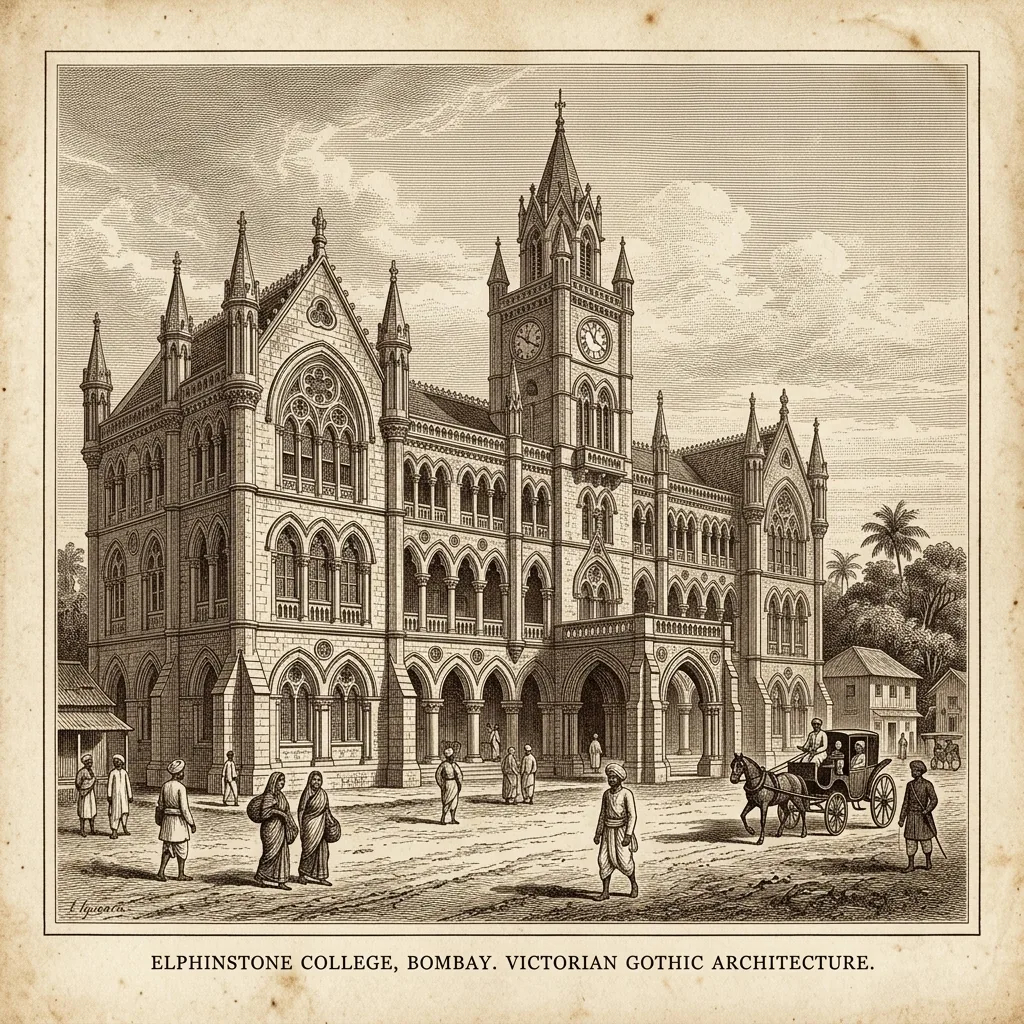
Elphinstone College (1856)
Jagannath “Nana” Shankarshet and the Making of Modern Education in Bombay
At nineteen, Nana Shankarshet began asking a question that would shape much of his life: what would it take to give Bombay a modern education system, and who should that system actually serve?
The answer was far bigger than building a few schools. Nana helped raise the money and lay the foundations for Elphinstone College and the University of Bombay. But he also fought over what students should learn and in which languages, pushed education beyond Bombay's established elites, supported girls whose families were afraid to send them to school, backed schools for working communities, and defended Sanskrit and India's classical traditions within a rapidly changing educational system.
Again and again, Nana moved beyond philanthropy into something more difficult: challenging the way education itself was being designed. He put his money behind young reformers, his reputation behind controversial experiments, and eventually his own family behind the new idea of Western education.
The story that follows is not simply about the institutions Nana helped create. It is about the argument he spent decades making: that modern education could transform Bombay without leaving its people, languages and intellectual traditions behind.
1. Elphinstone College and Institution (1820s-1830s)
Nana Shankarshet was only nineteen when he began working on the problem that would shape much of his life: how could Bombay give its people a modern education?
In 1822, he became a founding member of the Bombay Native School and School Book Society, helping to build an educational system even before the Elphinstone Institution existed.
Then, in 1827, Bombay wanted to honour Governor Mountstuart Elphinstone, who had encouraged native education. At a public meeting in the Town Hall, Nana was chosen to help lead the Elphinstone Testimonial Fund. He was still in his early twenties.
Nana personally contributed ₹25,000 (a huge sum for the time), helping persuade other Indian merchants and European residents to contribute. Together, they eventually raised around ₹3.5 lakhs.
The Testimonial Fund Deadlock: Raising the money was only the beginning. For several years, the fund sat in a frustrating deadlock. The British authorities in London were slow to approve the appointment of professors, uncertain about the value of providing higher education to Indians. Nana and the other members of the committee kept pressing. In 1834, their efforts succeeded, and on February 1, 1835, classes finally began in the Town Hall.
The institution had finally come to life. But Nana's contribution went well beyond raising money. He wanted education to reach ordinary Indians, not just a small English-speaking elite. When Sir Erskine Perry later pushed for English to become the sole medium of instruction, Nana opposed him.
In a formal Minute of Dissent in 1847, Nana argued that English could never be the practical medium for educating the whole population. For him, Marathi, Gujarati and the other vernacular languages were essential if education was to reach the wider public.
That argument reveals something important about Nana: he was not simply funding an institution designed by others. He was arguing about what education was for, and who it was meant to serve.
He also put his own family behind the experiment. Nana sent his son, Vinayakrao Jagannathji Shankarshet, to study at the Elphinstone Institution. At a time when some orthodox Hindus feared that Western education could lead to Christian proselytization, this was a powerful personal statement.
Nana did not simply ask Bombay's families to trust this new kind of education. He trusted it with his own child.
The institution continued to evolve. It operated under the Board of Education from 1840, with Nana serving as one of its original Indian members, and in 1856 the Elphinstone Institution formally separated into Elphinstone High School and Elphinstone College.
Its influence would eventually reach far beyond the classrooms where those first students gathered. Dadabhai Naoroji, Justice Mahadev Govind Ranade, Gopal Krishna Gokhale, Bal Gangadhar Tilak and C. D. Deshmukh would all become associated with the institution and with the intellectual and political life of modern India.
And there is a physical reminder of where this story began. The first higher-education classes were held in Bombay's Town Hall. The building survives, and Nana's statue by Matthew Noble stands there today, in the very hall where the institution's earliest students once sat.
The college moved through different locations as it grew, but the idea Nana helped establish remained constant: Bombay's future would depend not only on commerce and infrastructure, but on educating its people.
That idea began with a nineteen-year-old member of a school committee, and grew into one of Bombay's most important educational institutions.
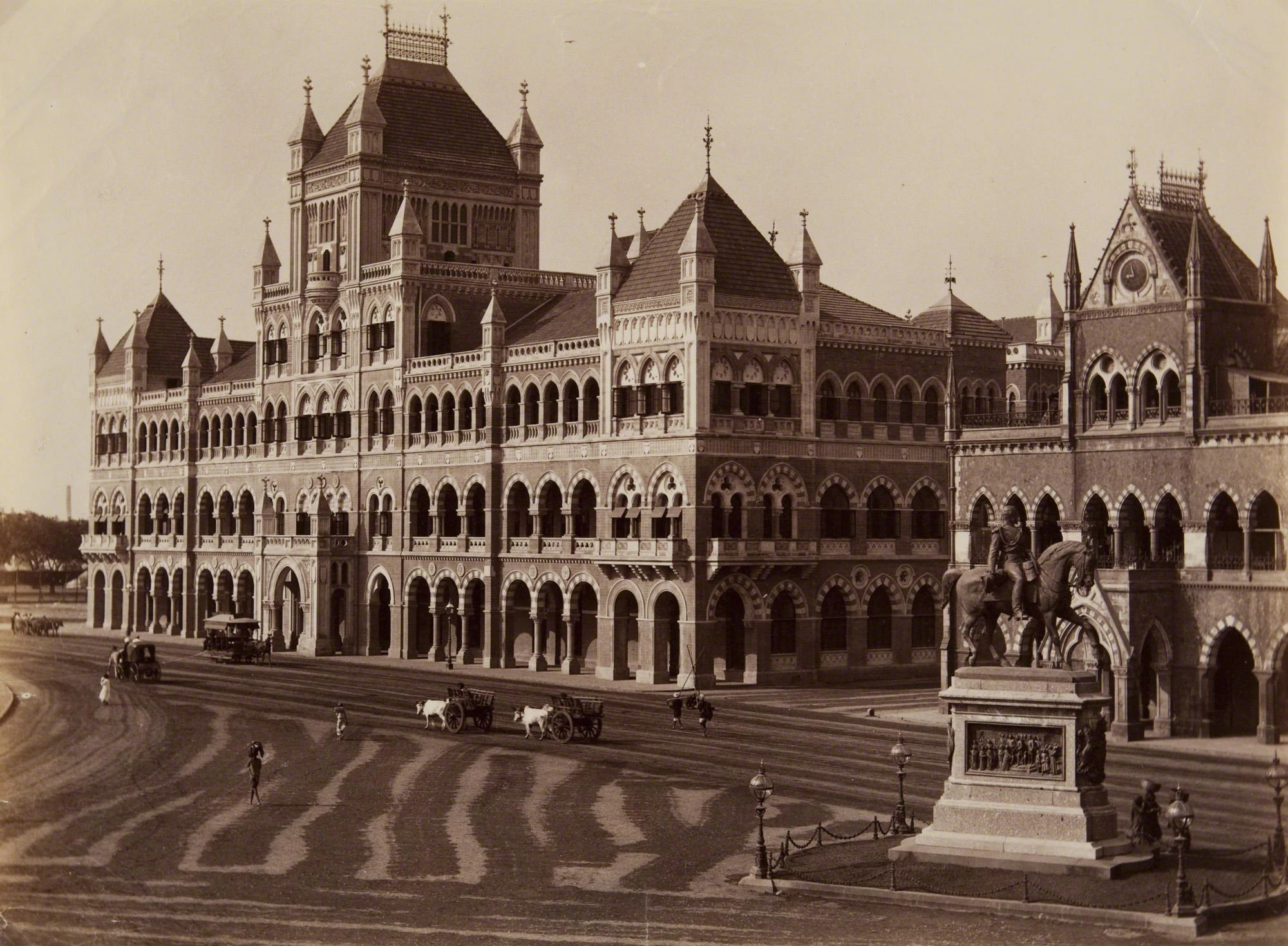
Elphinstone College, Kala Ghoda, late 19th century
The magnificent building associated with Elphinstone College today was completed in 1888, more than two decades after Nana's death. During Nana's lifetime, the institution operated from the Town Hall and later from Tankerville at Gowalia Tank.
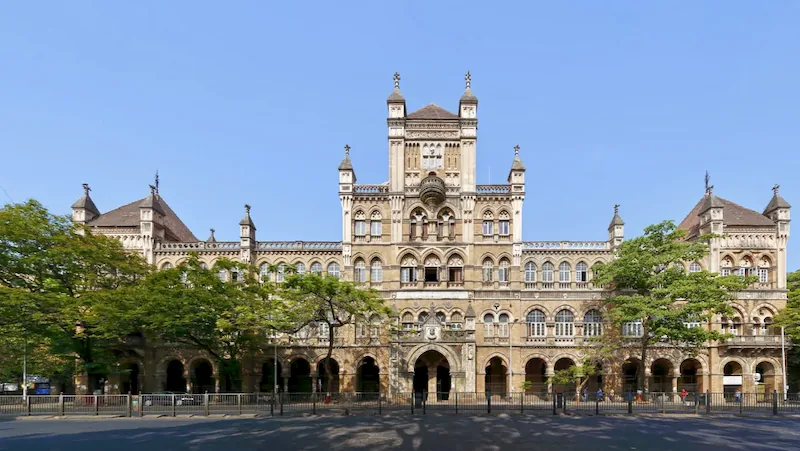
Elphinstone College, Kala Ghoda, modern view
A modern view of the same 1888 Gothic Revival building at Kala Ghoda. The structure continues to house the institution today, serving as a lasting symbol of the higher education movement Nana Shankarshet co-founded in the early 19th century.
2. University of Mumbai (1857)
The University of Mumbai did not begin with a university building. It began with an idea Nana Shankarshet had been working on for decades: that Bombay needed an educational system capable of taking its students beyond basic schooling and into higher education.
Incorporation Amid Rebellion: The University was formally incorporated in 1857, following Charles Wood's Educational Despatch of 1854. Remarkably, the Act was passed on July 18, while the 1857 Rebellion was raging across northern India.
By then, Nana was no newcomer to the cause of education. He had been involved in Bombay's educational institutions since the 1820s, helping build the foundations on which the University would eventually stand. He was one of the few people whose involvement continued across these different stages: from the Bombay Native Education Society, to the Board of Education, and finally to the University's Senate.
In 1857, the British government appointed Nana as one of the University's Founding Fellows and to its inaugural Senate, alongside figures such as Sir Jamsetjee Jeejeebhoy and Dr. Bhau Daji Lad.
The University was initially designed not as a teaching institution in the modern sense, but primarily as an examining body assessing students emerging from the high schools and colleges of the Bombay Presidency. Nana remained on its Senate until his death in 1865.
Preserving Vernacular Heritage: When British officials sought to reduce the place of Sanskrit and vernacular languages in education, Nana resisted. He supported English for science and administration, but successfully argued for preserving India's classical and vernacular traditions within the emerging university system.
For Nana, the challenge was to make modern education part of Indian society without making it entirely foreign to it.
Then came the University's first graduates. Its first convocation was held on May 1, 1862. Among those receiving B.A. degrees were Mahadev Govind Ranade and Ramakrishna Gopal Bhandarkar, students who would themselves become leading figures in the intellectual life of India.
Nana did not live to see the full shape of the university that he had helped build, but his legacy remains:
1. A Sanskrit scholarship was established in his name in 1866, a year after his death, by his son Vinayakrao and citizens of Bombay, becoming a prestigious hallmark of classical learning in Maharashtra.
2. At the University's Convocation Hall, a marble tablet records him among the Founding Fellows as "Jugonnath Sunkersett, Esq."
The university buildings that Mumbai recognises today came later. Nana never saw the Rajabai Tower or the Convocation Hall as we know them, but he helped lay the educational foundations on which they were built.
At the fifth convocation, Governor Sir Bartle Frere acknowledged the absence of Nana, who had died only recently. The recognition was fitting: the University was the next stage of an educational project Nana had been helping Bombay build since he was a young man.
3. Sir J.J. School of Art (1857)
By the middle of the 19th century, Bombay had become one of India's great commercial cities. But there was a problem: the city had very few institutions where people could learn the industrial and fine arts. An 1852 article in the Telegraph and Courier drew attention to this gap, urging Bombay's leaders to act.
Sir Jamsetjee Jeejeebhoy answered the call. In 1853, he offered Rs 1 lakh to establish a school of painting and design. Nana Shankarshet threw his full weight behind the project.
Artisan Roots & Practical Craft: For Nana, the school had a personal significance. His father, Shankar Sheth, had built the family's fortune as a jeweller and financier. This was not simply a school for fine art in the European tradition. Nana wanted it to serve and upgrade the skills of Bombay's working artisans.
When the proposal was approved by the Court of Directors in England, a four-man sub-committee consisting of Nana Shankarshet, W. Yardley, John Harkness, and Rustomjee Jamsetjee was formed to work out the school's plan, focusing on the practical needs of the native artisan classes.
The ambition was not simply to teach fine art, but to give local craftsmen the technical skills (such as geometry and perspective) that could strengthen their own livelihood.
On March 2, 1857, the Sir J.J. School of Art was officially inaugurated. Its first classes were held at the Elphinstone Institute, and Nana served on the inaugural management committee chaired by E.J. Howard.
What began as an attempt to strengthen Bombay's artistic and industrial skills would grow into one of Asia's leading art institutions, producing generations of celebrated painters, sculptors, and architects. Nana helped shape a place where Bombay's traditional craftsmanship could meet new techniques, and where the city's artisans could learn to compete in a changing world.
4. Board of Education and First Educational Survey (1840s)
In 1840, the British government reorganized education in the Bombay Presidency, replacing the Bombay Native Education Society with a new Board of Education. Nana Shankarshet was appointed as one of its founding native members, a position he would hold for 15 years.
But Nana was not content to sit on the Board and watch education expand slowly from the top down. He soon found himself at odds with its chairman, Sir Erskine Perry. Perry favoured concentrating limited funds on English education in Bombay and Poona, while Nana argued that mass education could not be built that way. If children were to learn, he believed, schools had to reach them in their own language.
The disagreement became a serious battle over the Board's priorities.
The 1847 Minute of Dissent: When Sir Erskine Perry's proposal threatened to halt the expansion of primary education into Poona and the districts, Nana did something unusual. Realising he was being outvoted, he formally recorded his opposition in a Minute of Dissent alongside Framji Cowasji Banaji and Mahomed Ibrahim Makba, successfully shifting government support back to vernacular education in 1848.
A Hindu, a Parsi, and a Muslim stood together, united in their defense of mass vernacular education.
But Nana's bigger question remained: How many children were actually being left out? In 1846–47, he travelled through Maharashtra to see the educational situation for himself. Then, in 1849, he helped lead Bombay's first systematic educational survey.
First Systematic Educational Survey (1849): The city was divided into five districts, with Nana personally going house-to-house in Girgaum. The survey revealed that of 7,525 children counted across the city, 1,716 were receiving no education at all. This finding shifted attention toward primary schooling and introduced the state-subsidized grant-in-aid system.
Nana had started with an argument inside a government committee, and ended up taking the question to the streets of Bombay. The survey turned the problem of education from an abstract debate into something the Board could count, see, and act upon.
5. Girls' School in Girgaon (Disputed Dates: 1830s-1849)
Female education faced strong social resistance in 19th-century Bombay. The surviving accounts point to two important stages in Nana Shankarshet’s involvement.
The Mansion School (circa 1837–38): When Scottish missionary Rev. Dr. John Wilson struggled to find premises for a girls' school, Nana offered a wing of his Girgaum wada, sending girls from his own family to study there to break the conservative social taboo.
When the Students' Literary and Scientific Society expanded its girls’ schools in 1849, Nana became an important financial patron and fully supported one of the schools near his estate.
In February 1852, Nana hosted a prominent award ceremony for female students at his mansion, presided over by Governor Lord Falkland, to give female education a prestigious public spotlight.
6. School for Koli Fishermen's Children
Nana’s educational work also extended beyond Bombay’s established elites. During the 1849 educational survey of Girgaum, he observed the limited access to schooling among children of the Koli fishing community around Girgaum Chowpatty. Poverty and the demands of hereditary work made formal education difficult to access.
Fishermen's Children School: Observing the Koli community's exclusion from schooling during his 1849 survey, Nana established a school for their children at his own expense and personally monitored student progress.
The initiative is significant because it extended Nana’s educational work to a community that had been largely excluded from formal schooling. It also reflected the broader concern, visible in his 1849 survey, that lack of access to education was closely connected with poverty and social problems.
7. The Sanskrit Scholarship (1866)
Nana Shankarshet believed that India's future did not require abandoning its past. Throughout his life, he defended the place of Sanskrit in education, arguing that classical languages were part of India's intellectual and cultural inheritance. He wanted Sanskrit to retain a place within the new educational system the British were building.
As a member of the Board of Education, Nana argued in the 1840s against proposals to push Sanskrit aside in favour of an English-dominated curriculum. He also supported the idea that the old Dakshina fund (originally used by the Peshwas to support Brahmin scholars) could be redirected towards scholarships and education rather than simply disappearing into government coffers.
Then, in 1857, Nana became one of the original Fellows of the newly established University of Bombay. It gave him a place inside the very institution that would eventually carry his name into the next generation.
Establishment of the Sanskrit Scholarship (1866): A year after Nana's death, his son Vinayakrao and the citizens of Bombay donated Rs 30,000 to the University of Bombay, establishing the Honorable Jagannath Shankarshet Sanskrit Scholarship to honor his lifelong defense of classical studies.
It was the institutional continuation of an argument Nana had made for decades: that modern education and India's classical intellectual heritage did not have to be enemies.
The scholarship became a significant recognition for Sanskrit scholarship. But there is an interesting detail hidden in its early history. R.G. Bhandarkar is sometimes described as an early or first recipient. The dates do not fit. Bhandarkar graduated in 1862, while the Shankarshet scholarship was created only in 1866. The University's records instead identify the first recipients as Govind Ramchandra Bhagvat in 1866, Nilkanth Vinayak Kitre in 1867, and Mahadev Moreshvar Agashe in 1868.
The scholarship continued to create a lineage of scholars. Among its later recipients was P.V. Kane, who would eventually become one of India's most celebrated Sanskrit scholars.
Nana's support for Sanskrit also extended into his own home, where he maintained a circle of Sanskrit scholars and supported visiting Shastris. For Nana, Sanskrit was not simply a subject to be preserved in a university curriculum. It remained part of a living intellectual tradition.
The scholarship itself would later change with the education system around it. As university-level Sanskrit study declined, its rules were eventually adapted, and the award evolved into a prize associated with outstanding performance in the statewide 10th-standard examination. The form changed; the name, and the connection to Nana, remained.
8. Students' Literary and Scientific Society
In 1848, a group of young professors and students connected with the Elphinstone Institute decided that learning should not stop at the classroom door. On June 6, they founded the Students' Literary and Scientific Society (SLSS), with the young Dadabhai Naoroji among its leaders. Their ambition was larger than intellectual debate. They wanted to spread useful knowledge and tackle some of Bombay's social problems.
A Crucial Coalition: These young reformers had ideas and energy, but lacked funding and social standing. Nana provided his property, financial support, and public protection to help their schools survive.
The partnership became particularly important when the Society decided to open vernacular schools for girls in 1849. Educating girls was controversial enough; doing it through a group of young Western-educated reformers made some families even more suspicious. Rumours of Christian conversion added to the resistance.
The schools faced a genuine fight for survival. The young volunteers taught the girls themselves, often in the early morning before going to their regular work. Dadabhai Naoroji and Bhau Daji Lad were among those who gave their time. But enthusiasm could not solve the larger problem: parents needed to believe that sending their daughters to these schools was safe and socially acceptable.
Nana gave them that protection. He offered his property and his financial support, and his public standing gave the young reformers something they could not create for themselves. He also became President of the Marathi Dnyan Prasarak Sabha, the Marathi branch associated with the Society.
This was more than a donation. Nana was effectively putting his own reputation and public standing behind the experiment. When conservative critics opposed the schools, Nana did not step back. Dadabhai Naoroji later remembered that Nana had "cheered us on" and supported one of their schools when the masses were against them.
The relationship between the generations is what makes the Society's story so revealing. The young reformers brought new ideas and the willingness to teach them. Nana brought money, property and the authority of an established Bombay Sheth. Together, they made it possible for an experiment led by young reformers to survive and lay the groundwork for modern schooling.
The SLSS became a meeting point between two generations of Bombay reformers: the young men who wanted to change society and the older philanthropist who had enough standing to help them make those changes real. Nana did not lead the movement by himself; he made it possible for the next generation to lead it.