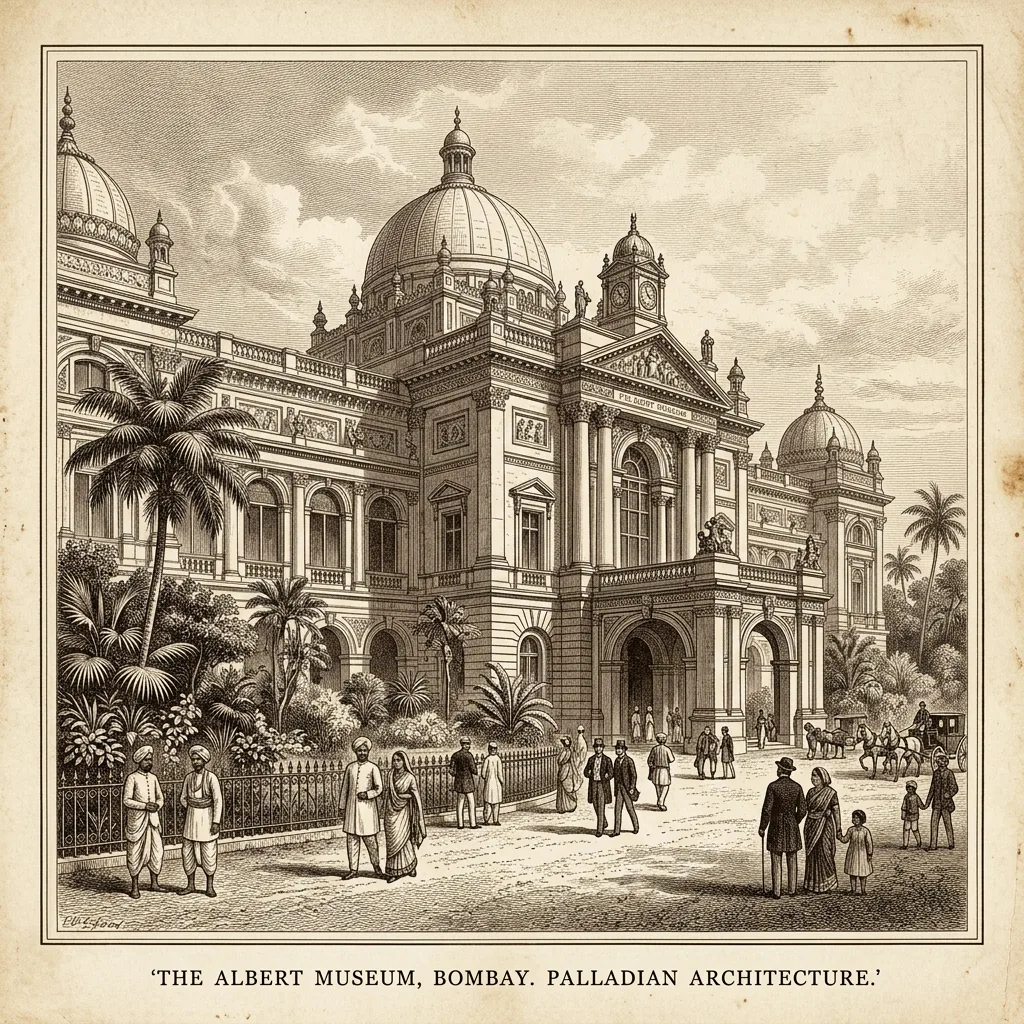
The Albert Museum, Bombay (Established 1862)
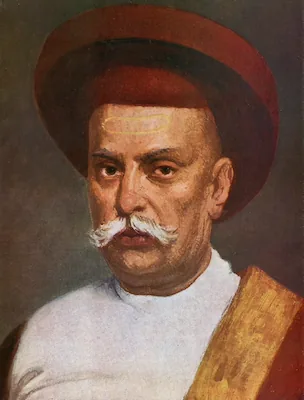
Jagannath “Nana” Shankarshet and the Making of Civic Life in Bombay
What does it take to turn a growing settlement into a city, and, perhaps more importantly, to turn its people into citizens?
For Nana Shankarshet, building Bombay was never only about roads, buildings or commerce. It was about creating the places, institutions and public systems through which people could live, participate and have a voice.
He helped bring water, drainage and gas lighting to the city's streets. He fought to preserve public open spaces as Bombay expanded beyond its old Fort walls. He gave his own land to build a theatre, then helped transform it from a venue for European entertainment into a stage for Marathi and Hindustani performance. He helped create the gardens and museum that would become Rani Baug and the Dr. Bhau Daji Lad Museum.
But Nana's civic life extended beyond physical improvements. He became one of Bombay's earliest Indian Justices of the Peace, negotiated with the colonial government over taxes, intervened when new levies threatened traders and food supplies, and helped create the Bombay Association, the city's first organised political platform through which Indians could collectively make their demands heard.
What makes the story especially revealing is where Nana stood. He was wealthy enough to sit inside the institutions of colonial power, but connected enough to understand what those decisions looked like from the street. Again and again, he used that position as a bridge between the two.
The story that follows is therefore not simply about the civic projects Nana helped create. It is about the emergence of a public life in Bombay, and a man who helped Indians find their place within it.
1. Badshahi Natyagruha Theatre (Opened 1846)
In the late 18th century, European residents had built the Bombay Theatre near Elphinstone Circle. By the 1830s, however, the theatre was deeply in debt and was eventually sold. Bombay was left without a major theatre, and the money associated with the old theatre became tied up in a dispute over how it could be used.
In 1841, a new theatre committee was formed. Nana Shankarshet and Framji Cowasji represented the Indian interests on the committee. When the government agreed to release funds from the earlier theatre but refused to provide land in the Fort, Nana offered something more tangible: his own plot on Grant Road.
Grant Road's Entertainment Frontier: At the time, Grant Road was not the centre of Bombay's entertainment world. The causeway had only recently been constructed, and the area was still surrounded by orchards and gardens. That was where Nana chose to build the new theatre.
The Badshahi Natyagruha (or Royal Theatre) opened on February 10, 1846. It began with English farces and performances for visiting European troupes, but the theatre struggled financially. By 1852, it owed ₹4,000 to Remington & Co. and was in danger of being sold. Nana stepped in and paid the debt himself.
That rescue changed more than the theatre's finances. As chairman of the theatre committee, Nana increasingly pushed it beyond its original role as a venue for English entertainment. He wanted the theatre to benefit a wider public and encouraged performances in Indian languages.
On March 9, 1853, the theatre hosted a landmark Marathi performance by Vishnudas Bhave's troupe from Sangli. Bhave came from the traditional Dashavatar performance tradition, and Nana helped bring his troupe to Bombay and onto the European-style proscenium stage.
Later that year came another experiment. With Dr. Bhau Daji Lad, Nana helped facilitate a performance of Raja Gopichand in Hindustani/Hindi. Theatre historian Dr. A.A. Nami identifies it as the first documented full-length Hindustani play performed in a formal proscenium theatre.
What began as a theatre for English entertainment became the proscenium stage where Bombay's own Marathi, Hindustani, and Gujarati theatrical traditions found a public voice.
And the location itself left a curious trace. The theatre stood near Grant Road and Sleater Road. The original building is gone, but the surrounding entertainment district eventually became known as "Pila House", generally understood as a local rendering of "Play House," a name that survived even after the theatre itself disappeared.
2. Agri-Horticultural Society, Victoria Gardens (Rani Baug), & Albert Museum
For 35 years, Nana Shankarshet was closely involved with Bombay's Agri-Horticultural Society, helping shape an institution that combined public recreation with agricultural learning, botanical study and the appreciation of Indian craftsmanship.
Its story began with a garden at Sewri. But Nana believed the garden needed to be somewhere people could actually reach. The Society eventually moved to the Mount Estate at Byculla, where 33 acres were acquired for a much larger public garden and museum.
On December 15, 1857, Nana chaired a meeting at the Town Hall to mobilise public support for the project. He was the first to subscribe, giving Rs. 4,000 of his own money. More than 150 citizens followed, together raising Rs. 75,000.
Patronage Amid Rebellion: The meeting occurred while the Indian Rebellion of 1857 was raging in northern India. With authorities deeply concerned about stability, the garden and museum were publicly presented as institutions honouring Queen Victoria and Prince Albert. For Bombay's Indian elite, supporting the project became a vital way of demonstrating civic loyalty and maintaining trust at a moment of extreme political uncertainty.
Nana's role was more than ceremonial. He chaired the committee, put his own money forward first, and helped bring other Indian donors into the project. He also understood that a garden could be useful for more than strolling.
The Agri-Horticultural Society experimented with plants and seeds of practical value for the Bombay Presidency. Among the material associated with Nana were exotic crops and fibres, including Mauritius sugarcane and Egyptian cotton, which became crucial during the cotton shortage caused by the American Civil War.
The project eventually produced the Victoria Gardens (now Rani Baug) and the Albert Museum (now the Dr. Bhau Daji Lad Museum). Nana did not live to see the entire project completed, but the foundation stone laid in 1862 carried his name as President of the committee, buried beneath it in a copper urn.
Dr. George Birdwood later credited Nana with helping shape the museum's purpose as a place that could preserve and display the living arts of Indian artisans.
By 1865, the gardens were struggling financially. On the evening of July 17, 1865, Nana called an urgent meeting of the Agri-Horticultural Society, making a passionate appeal to keep the garden alive. That very night, Nana returned home and fell ill with a severe fever, passing away on July 31, 1865.
Today, Rani Baug and the Dr. Bhau Daji Lad Museum still occupy the landscape that grew out of that project, serving as a lasting testament to his vision of public knowledge, agricultural experimentation, and native craftsmanship.
3. Municipal Committees & Utilities
Nana's influence on Bombay was also involved in the everyday machinery of a growing city: its courts, water supply, sanitation, roads, lighting and public spaces.
In 1834, he became one of the first twelve Indians appointed as Justices of the Peace (J.P.) in Bombay. The appointment followed years of pressure, including an 1826 petition Nana signed seeking the right for Indians to serve on juries. He sat in the Court of Petty Sessions, hearing minor disputes and criminal cases.
When the Board of Conservancy was established in 1845 to deal with aspects of the city's health, sanitation and taxation, Nana served as an Indian representative. When a contentious House Tax was introduced to fund municipal improvements in 1852, a large public meeting was held at Nana's house. Nana led a delegation to the Governor to negotiate how the tax was collected and spent.
His civic work was often just as practical.
The Shankarshet Tank (1846): During the severe water shortage of 1846, wells across Bombay ran dry. Nana owned a private lake or tank near Grant Road. He spent his own money deepening and clearing it, then handed it over to the government so that people could obtain water during the crisis. It became known as the Shankarshet Tank.
A few years later, Nana supported the Vihar Lake water-supply project, inaugurated in 1856, which brought piped water to Bombay. In 1857, he also advocated an underground drainage system to replace the city's open drains.
Water was not the only problem. Bombay was still physically constrained by its old Fort walls. Nana served on the committee involved in their removal in the early 1860s. As the ramparts came down, he argued that the reclaimed space, the Esplanade, should remain public open space.
Then came another transformation: light. Nana was among the local promoters of the Bombay Gas Company, helping secure the contract to introduce gas street lighting. He publicly championed its safety to reassure nervous residents, and on May 26, 1865, the first gas lamps were lit along the city's streets.
Nana's municipal work rarely produced a single spectacular monument; instead, it touched the everyday systems that made a city work: water, drains, open spaces, and light.
4. The Bombay Association (1852)
In 1852, Bombay's Indian residents gained something they had not had before: an organised political platform through which they could present their concerns to the colonial government.
The Bombay Association was established on August 26, 1852, with Nana Shankarshet as its President and Sir Jamsetjee Jejeebhoy as Honorary President. Its membership brought together Hindus, Parsis, Muslims and Gujaratis, along with some of the city's emerging young intellectuals, including Dadabhai Naoroji and Dr. Bhau Daji Lad.
The Association's first major challenge came almost immediately: preparing a petition to the British Parliament ahead of the 1853 renewal of the East India Company's charter. They demanded greater Indian participation in higher administrative services, representative legislative councils and changes to the Company's system of government.
A Choice of Principles: The petition created a split. Younger members wanted the document to speak plainly about the Company's excessive expenditure and autocratic rule. Established merchant leaders wanted the language softened to avoid antagonising the British. Nana chose to stand behind the stronger version, accepting the resignation of Jejeebhoy and others in October 1852 to give the younger generation room to challenge the system.
The young men behind some of these arguments were very different from Nana. Dadabhai Naoroji was only 27, and Bhau Daji Lad was a young physician. Nana, at 49, was already an established figure with the wealth, reputation and access to British officials that the younger generation lacked.
The younger reformers brought intellectual energy and detailed arguments; Nana provided the political weight and the bridge to colonial power.
Nana also understood that a petition written in Bombay needed someone to carry its argument beyond India. The Association developed links with reformers in Britain, including John Bright, and supported the India Reform Society in London, carrying Indian grievances directly into British political circles.
The Association's meetings were connected to Nana's residence in Girgaon, where the family's Shankarshet Ram Mandir still stands today. Inside the Town Hall, a statue of Nana by Matthew Noble stands as a physical memory of this political pioneer.
After Nana's death in 1865, the unifying force he had provided was gone. But the political habit it represented, that of Indians organising across community lines to present grievances collectively, laid the direct foundation for the next generation of organised Indian politics.
5. Tolls, Taxes, and Advocacy
Nana's civic work was often most visible when Bombay's taxes collided with the daily lives of ordinary people.
One of the clearest examples came in 1845, when the British introduced a 7% tax on the annual value of houses to fund policing. Shops closed, and a large crowd gathered at the Town Hall. Nana stepped into the middle of the dispute, negotiating a reduction to 5% and securing a commitment that the funds would be used for local civic purposes, before persuading the protestors to disperse.
Six years later, the dispute was over something even more basic: getting food into Bombay.
The Wheel Tax Bullock Cart Strike (1851): In February 1851, the Board of Conservancy imposed a "Wheel Tax" on bullock carts entering the city. These carts carried grain, cotton, and vegetables. Thousands of cart drivers went on strike, bringing the docks to a halt. Nana invited the strike leaders to his residence, helping them frame a petition in Marathi and English that focused on the city's essential food supply.
His advocacy also extended to the tolls imposed on the roads into Bombay. At the Sion Causeway, Nana argued that the toll had already recovered the causeway's cost and had effectively become an unfair tax on farmers bringing produce from the mainland.
There was, however, another side to Nana's position. He was himself a wealthy landowner and had a personal interest in property taxes. British administrators regarded him as a difficult member of the Board of Conservancy. Was he simply protecting his own interests?
The evidence complicates that explanation. His strongest interventions included opposition to the Wheel Tax and the Salt Tax, levies that did not primarily target his own property but affected traders, labourers and poorer communities.
Nana's civic advocacy cannot be reduced neatly to either a champion of the people or a wealthy landlord protecting his interests: he was a powerful property owner willing to use that power on behalf of people with considerably less of it.
He understood how the colonial administration worked from inside its institutions, but he also understood what its decisions looked like from the street. His influence lay in being able to speak to both worlds.